Unknown's avatar

About Strings2u

Violin Seller and Violin Teacher

Violin Sizes – how much to pay – 1/16, 1/10, 1/8, 1/4, 1/2, 3/4, 7/8, 4/4

HOW BIG ARE THEY AND HOW MUCH SHOULD I PAY? I’ll answer the first part and then talk about the second part later so please read on:

1. JUST HOW BIG ARE THEY? Just like shoe sizes, we can buy different sized violins for all ages. Below is the actual length in Inches and Millimetres.

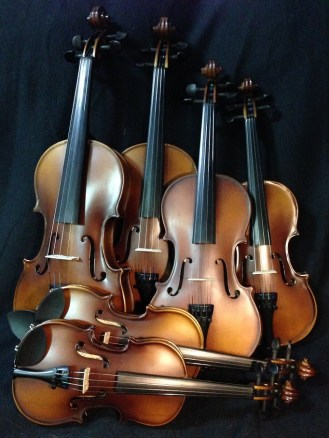
Violins come in the following sizes and total length:

1/16 – 37cm (14.5″); 1/10 – 41cm (16″);    1/8 – 44cm (17.5″); 1/4 – 48cm (19″);

1/2 – 52cm (20.5″);   3/4 – 55cm (21.5″); 7/8 – 57cm (22.5″); 4/4 – 59cm (23.5″).
MV100-small

The smallest is the 1/16th size violin which is used for a 3-4yr old. The biggest is a 4/4 size which is also called a full-sized violin. As you can see, violins are in “fractional” sizes because of the use of fractions.

This can be misleading though, as a 1/2 size violin (52cm) is not a 1/2 of the size of a 4/4 (59cm) or full-size violin.


2. HOW MUCH SHOULD I PAY?

This is a great question. I have searched on the internet for different opinions to give a balanced answer. Here is what I found:

PARENT No.1: “So, onto violins. Small violins seem to me to be “sound impaired” no matter what brand you buy. So, as long as the instrument is set up well, does it really matter about the “quality” of said instrument? Right now I can buy any number of 1/4 violins off e-bay for under $100, including a Strunal 220 that seems to get reasonable reviews from reputable sources. So, again, how much does “quality” matter when we are talking about a small instrument that a child will outgrow?”

MY RESPONSE:  Quality does matter a lot even though a child does possibly outgrow the violin in a year. The difference in sound can be described as the difference of sounding like heaven to sounding like hell. Poor sounding violins can sound horrid, horrible, abysmal etc. As a teacher, I just can’t listen to a poor instrument as it effects the child more than you think. Most often, the child will just stop practicing as they don’t enjoy the sound. Recently, I even gave one of my young students a free instrument loan because their instrument was very poor sounding.

PARENT No.2: “I spent the last 6 months looking for a 1/2 size violin for my son. I looked through the internet, went to a couple of violin shops. My son wanted a brand new one. We tried three that he liked. One was Wilhelm Klier which he liked best of the three until his violin teacher contacted a local luthier and brought an old violin which is probably 75 – 100 years old. It looks really beat up, but the sound was no comparison. Even with a fractional size, it sounded so mature and the high register sounded very clean. He just fell in love with it despite its appearance. The Wilhelm Klier outfit was $1500 (which is still a very good violin) and this old one was $750. You might want to check local violin shops and try to find an old one. A lot of times, not always, the older the violin, the better the sound it will produce. I think it is so important that a violin has the capability to produce beautiful sound from the beginning of your son’s violin study. You might be able to find a reasonably priced one if you take your time.” 

MY RESPONSE:  This parent is absolutely right in everything he/she said. It has been my experience also that: “A lot of times, not always, the older the violin, the better the sound it will produce.” For this reason I have made a great effort to find and sell 100 year old fractional violins. Why do they sound better? The main reason is due to the 50-100 year age of the wood in antique violins. By comparison, the majority of new violins are only aged a few years, so the sound is not as resonant. Old fractional violins are quite rare but surprisingly they are as affordable as comparable quality new violins. However, not all old violins sound the same, so I price them accordingly. New violins also vary quite a lot in their sound, which is why I personally select all the new violins that I sell.

A VIOLINMAKER’S OPINION: “Because (as stated above) fractional instruments are transitional, over spending does not make sense in my opinion.  We have carried many different 1/2 sized instruments at different price ranges in our shop and have decided that our higher end 1/2 sized instruments should fall in the $750 to $1,250 range with 3/4 going a bit higher.  This range allows a significant improvement over your current violin without breaking the bank.”

MY CONCLUSION: There is a big difference in sound between the beginners’ violin and the mid-range violin even on fractional violins. The beginners’ violin that I sell costs $150 and it sounds better than other similarly priced violins-believe me I have tried them all. The mid-ranged violin costs $320 and has a superior sound. Because it is a better sounding and better looking violin it has a resale value so it can be used as a trade in on the next mid-ranged violin. This more than justifies getting the mid-ranged violin. Of course, if you are not sure whether the child will continue to learn then start with a beginners’ violin first.

Another reason why the sound of the violin is important is that it will encourage the student to practice and progress faster. Considering the major investment of money in regular lessons (approx. S$1,400), then the cost of the violin is considerably less.

Hope this has been helpful.

BUYING a VIOLIN in Sydney

BUYING a VIOLIN in Sydney:

MV100-small

BEGINNERS MV100 Violin for $290-$390 at Strings2u


Buying a VIOLIN can be an expensive affair. Of course, you want to have the best sounding violin for your money. However, it is difficult to know if you are really getting your money’s worth or over paying. 

HOW CAN I HELP? As a teacher, I have been helping students to get the best sounding violin for their money.

HOW MUCH SHOULD I PAY?
For the beginners violins $290-$390, I select the best sounding violins so you may not need to pay more to get a good sounding violin.
For ADVANCED violins, YOU SHOULD PAY A LOT LESS than the retail price as Strings2u prices are around HALF THE PRICE. This is because I do not have to cost in the overheads such as rental and staff salaries.
Buying from Strings2u situated at Chisholm St Wolli Creek Sydney, YOU SHOULD PAY A LOT LESS than the retail price for the ADVANCED violins. My prices are around HALF THE PRICE. This is because I do not have to cost in the overheads like a retail shop, such as rental and staff salaries.
Also, as a violin teacher I have selected the best sounding BEGINNER ($290) and INTERMEDIATE ($400-$500) violins for students, and set them up to sound their best.
 
TO SEE PHOTOS and DETAILED DESCRIPTION of the violins please click “New Violins” or “Antique Violins.”
 
BEGINNER’S VIOLIN: If you are just a beginner then I can supply you with a New Beginner’s Violin which costs ONLY $290-$390 (which includes the violin, the case, the bow and resin).
Once your boy/girl reaches 1/2 size and completes Book 1, then you can consider buying an intermediate violin. By then he/she will have enough skills to harness the qualities of a better violin.

INTERMEDIATE to ADVANCED Violin – beyond Book 1: A student is ready for an intermediate violin when they progress beyond Book 1. They will benefit from having a better sounding violin.

Intermediate to Advanced Violins are available as follows:
Chinese handmade Violins: 1/10, 1/8, 1/4, 1/2, 3/4 and 4/4 or full-sized.
Antique Violins: mostly 4/4 or full-sized and some 1/2 and 3/4 sized.
 
What’s the difference? The new Chinese Violins have a brighter sound while the antique violins have a warmer sound due to their age. In price there is not a significant difference. Both New and Antique Violins range from $590-$2190 and above.

What Size Violin Do I Need? – Fitting the violin by arm length

THERE ARE TWO METHODS OF DETERMINING WHAT SIZE VIOLIN YOU OR YOUR CHILD NEED:

METHOD 1:

A. MEASURE YOURSELF: Measure in inches, the length between your neck and the middle of your left-hand palm (when your arm is fully extended just like holding a violin).

B. CHOOSE THE RIGHT SIZE VIOLIN: Match the Violin Size given below with the measurement you have just taken. If your measurement is in between sizes, get the Violin Size that is below your measurement.
Violin Size – Arm Length in inches:
4/4 – 23 inches
3/4 – 22”
1/2 – 20”
1/4 – 18 ½”
1/8 – 16 ½”
1/10 – 15”
1/16 – 14”

METHOD 2:

If you don’t have a tape measure, there is a fast way to check:
A. Hold the violin in playing position on your left shoulder (preferably using a shoulder rest).
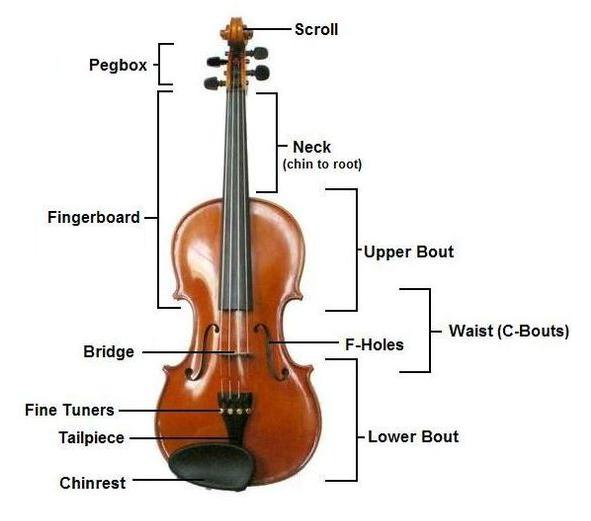
B. Extend your left arm further and with your left hand try to wrap your fingers all the way around the SCROLL (see diagram – wrap your fingers around the curled, round piece of wood at the end of the neck).

C. If you can see your finger nails wrapping around the scroll, then the violin is the right size and not too big for you. However, if you can wrap the fingers around without needing to straighten your elbow and arm, then the violin is too small for you and you need to try the next size.

(photo courtesy of Wikipedia)

Avoiding Climate Damage to your Violin

HEAT DAMAGE: Many years ago in Kuala Lumpur I left my beloved “Didion” violin in the boot of the car when I went from the Music School to a party. The problem was, I forgot all about it till I remembered around noon time the next day. Kuala Lumpur can be extremely hot and that day was. When I opened the case I was horrified to find that not only had all the strings come loose but the whole top of the violin had come off as the hyde glue had melted. Actually, if the glue had not come unstuck then the wood would certainly have cracked which thankfully it hadn’t. This is why repairs need to be done only with animal hyde glue and never with other glues. So I sent my violin off to London with a friend to have the top reglued.

At that time, I didn’t have my equipment to do the repairs myself. So what is the lesson that I learnt? NEVER, ever, put your violin in the BOOT of a car. Why? You might forget all about it like I did, and melt the glue. I recommend that you always take the violin with you when you leave the car in case someone breaks in and steals it. While we are on this subject, its also important not to put the violin near an airconditioner, a heat source, or an exterior wall. This will avoid extremes of temperature. 

ABOUT VIOLIN DAMAGE: LOW HUMIDITY causes CRACKSIn America this is a real problem as their humidity can be as low as 10-15%. So if you are traveling to a cold country you will need an HUMIDIFIER in your violin case. This contains moisture like a sponge and releases the moisture to humidify the air.

HIGH HUMIDITY causes WEAK SOUND: In Singapore, we don’t have the problem of low humidity and cracks, however, we do have the problem of high humidity causing weak tone. The solution is DEHUMIDIFIERS. Fortunately, if you leave your violin in a room that regularly has airconditioning, this problem is solved. An air conditioner dehumidifiers the air.

TYPES HUMIDIFIERS: There are two types of humidifiers: 1. those that go in the INSTRUMENT (e.g. “Dampit”  from $7.50 to $10 each) and 2. those that go in the CASE. Cases often come with both an hygrometer which measures the level of humidity and an humidifier which corrects dryness. An in-case humidifier often comes in the form of a small tube filled with water-saturated material that releases moisture at a controlled rate. For those with a D.I.Y. aptitude, you can insert several holes in a small plastic canister and insert a sponge inside which you will need to keep moist. This can be mounted inside the case with Velcro.

DEHUMIDIFIERS: For those who live in humid climates around the equator, you will need a DEHUMIDIFIER in the case. These usually consist of silicon gell or silicon pellet packets which absorb the moisture from the air in the case. They need to be placed in the microwave occasionally to remove the moisture that has been absorbed. 

(Reference: Strings magazine, October 2002, No. 105. “Drying Times – How to protect your instrument from climate changes” by Richard Ward)

More than just a bow

10 WAYS TO JUDGE THE QUALITY OF A BOW – or How do I know if my bow is any good?

Let me just start by stating the obvious. It is the bow which produces the sound on the violin. Obviously, not all bows are created equal. I continue to be surprised how using a different bow can make the same violin sound either incredibly better or much worse. You can get your perfect sounding violin without upgrading your violin by just upgrading your bow.

10 WAYS TO DESCRIBE A GOOD BOW:

SOUND: strong core, a lot of high overtones, a strong middle range

VOLUME: loud, low, focused, good carrying power

WEIGHT: light (ideally around 60 grams)

BALANCE: good balance not heavy at the tip or the frog

STRING CONTACT: even over the whole bow, including the tip, in the middle and the frog

BOUNCE: good over the whole bow, with good control

STABILITY: is stable along the whole stick, not breaking out to the side in the middle

STIFFNESS of wood: good, stiff at the frog, middle and tip

AESTHETICS: nice tip, frog, beautiful wood, mother of pearl, gold , silver, nickel mounted

FEEL: is comfortable in your hands.

Most professional violinists will have more than one bow in their case. One bow will be for medium tempo and the other lighter bow for faster tempo. It is important to mention that professional bows are made of pernambuco wood.

In the bow-making business it is usual to refer to some species other than Paubrasilia echinata as “Brazilwood”; examples include Pink Ipê (Handroanthus impetiginosus), Massaranduba (Manilkara bidentata) and Palo Brasil (Haematoxylum brasiletto). The highly prized Paubrasilia echinata is usually called “Pernambuco wood” in this particular context.

Reference: These tips come Chapter 11 of “A Bow on the Couch” found at https://www.andreasgrutter.com/a-bow-on-the-couch/

COURSE: CLASSICAL VIOLIN

COURSES:

CHILDREN BEGINNERS LEVEL-: Fiddletime Joggers Beginners Book is used as it has a easy to learn fun approach using different musical styles and an accompaniment CD. It starts with 10 pieces for open string melodies then 10 pieces for 1st finger, 10 pieces for 2 finger and 14 pieces for 3rd and 4th finger. This can be completed in 6-12 months.

CHILDREN INTERMEDIATE LEVEL: I use three books for this level:

Bk 1. Fiddletime Runners Book is used as it has MANY MUSICAL STYLES including CLASSICAL VIOLIN. This is followed by Fiddletime Sprinters

Bk2. Fiddletime Scales Books 1 & 2 are introduced for scales and arpeggios.

Bk 3. Suzuki Violin Book 1 is started at this level and continued through to Bk 10. 

A.B.R.S.M. Grade 1 through to Grade 8 books are used for those who request exams.

ADULTS: a combination of pop/american folk/Irish fiddle music and Suzuki Method -music reading is not a requirement unless requested. Adults can also request A.B.R.S.M. examinations if they are interested.

COURSE: CLASSICAL VIOLIN
GRADING SYSTEMS:
Associate Board of Royal School of Music (A.B.R.S.M.) Examination and Certification
OR
Trinity College of London Examination and Certification

AVERAGE TIME PERIOD NEEDED:
Beginner-first 6 months THEN
A.B.R.S.M. Grade 1 and SUZUKI Bk1 & Fiddletime Joggers    – 1 year THEN
A.B.R.S.M. Grade 2 and SUZUKI Bk1 & Fiddletime Runners  – 1 year THEN
A.B.R.S.M. Grade 3 and SUZUKI Bk2 & Fiddletime Sprinters – 1 year THEN
A.B.R.S.M. Grade 4 and SUZUKI Bk3 – 1 year THEN
A.B.R.S.M. Grade 5 and SUZUKI Bk4 – 1 year THEN
A.B.R.S.M. Grade 6 and SUZUKI Bk5 – 1 year THEN
A.B.R.S.M. Grade 7 and SUZUKI Bk6 – 1 year THEN
A.B.R.S.M. Grade 8 and SUZUKI Bk7 – 1 year THEN SUZUKI Bk8 etc.

***N.B. Where progress is accelerated it is possible to complete two Grades in one year. Examination is optional.

COURSE CONTENTS:
MUSIC LISTENING
TECHNIQUE
PERFORMANCE
MUSIC READING: this begins even with 4 yr old children.
MUSIC THEORY
REPERTOIRE: Classical, Pop, Latin, Folk including American and Irish Fiddle, etc.