Unknown's avatar

About Strings2u

Violin Seller and Violin Teacher

How to Improve the Sound of Your Violin

Improve your Violin Sound by Adjusting the Bridge!

You can do much more than finding the best strings for your violin. Most violinists should learn to ADJUST the POSITION of the BRIDGE to find the best sound.

There are three things you can do to the bridge to improve your violin’s sound!

I. ROCK the TILTING BRIDGE back to make the FEET FLAT on the belly;

II. MOVE THE BRIDGE CLOSER TO THE SOUNDPOST;

III. MOVE THE BRIDGE CLOSER TO THE BASS BAR;

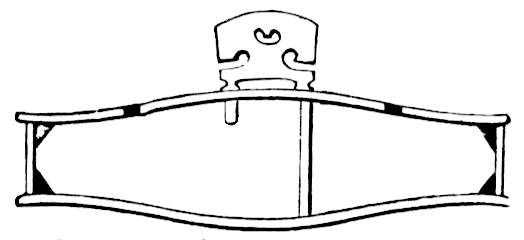
Here are some pictures of where the soundpost and bass bar are inside the violin:

Soundpost position-vertical behind bridge

Soundpost cross-section

Please follow the instructions below on an inexpensive $50 violin!

WARNING: DO NOT do the following with an EXPENSIVE VIOLIN!

Take expensive violins to a specialist at the violin repair section of a well know music store please.

I. TILT THE BRIDGE BACK TOWARDS YOU SO THAT THE FEET ARE FLAT ON THE BELLY (the front of the violin). This is by far the most common cause of a deteriorating sound from your violin. It is caused from the turning of the tuning pegs which pull the strings and the top of the bridge forward. As a result the bridge will tilt on its feet. The vibrations of the strings will not transfer fully to the violin. The remedy is very easy to execute and should be done at least once a month:

  1. Put the violin in your lap with the scroll facing away from you;
  2. Place your thumbs at the feet of the bridge and your middle fingers on the other side of the feet. You place your index fingers above the bridge: your left index finger on the bridge between the G and D string and your right index finger on the bridge between the A and E string.
  3. Now GENTLY ROCK THE BRIDGE BACK TOWARDS YOU as you press the bottom of the violin against you. The feet of the bridge will want to come back from a tilted position. When the feet are seated flat then they will not want to move any further back. Note that you will need to move against the pressure of the strings pressing on the bridge. However, to correct a tilted bridge does not need you to loosen the strings.

II. MOVE THE BRIDGE CLOSER TO THE SOUND-POST:

  1. Before you do anything, I recommend that you put a small strip of paper tape at the current position of the bridge so you can return it to its original position, if you want to.
  2. Look through the f-hole which is on the right side (E-string side) of the bridge and as you look behind the right foot of the bridge you will see a post which connects the front of the violin to the back of the violin. This is called the Sound-post.
  3. Check that the edge of the Sound-post is 2mm to 4mm behind the right foot of the bridge. The focus and volume of the sound varies according to this distance. A lot of Sound-posts are installed too far away from the bridge. As you cannot easily change the position of the Sound-post, I recommend that you change the position of the bridge.
  4. To change the position of the bridge, you must first loosen the strings slightly just enough to allow you to move the bridge. Do not loosen the strings too much as many soundposts are not fitted tightly inside the violin and may fall over. Only move the bridge 1mm closer to the soundpost and then retune the strings. As you try the violin you will notice that it is now more focused, louder and brighter. With trial and error you can find the perfect position of the bridge. You will know if you have moved the bridge too close to the soundpost when the sound starts to lose some of its resonance or ringing quality.
  5. If you don’t like the new sound, you can always move the bridge back to its original position to obtain your original sound.

III. MOVE THE BRIDGE to the left so it is CLOSER TO THE BASS BAR: This can improve the tone and balance of the strings.

Firstly, the TONE can be made warmer by moving the left foot of the bridge over the bass bar because the lower frequencies of each string are amplified by the bass bar. This is a very useful way to fix a violin which is too bright or shrill on the E and A strings.

Secondly, you can make each string’s volume the same by moving the bridge to the left or right to give what is called a BALANCED tone or sound.

  1. Before you do anything, I recommend that you put a small strip of paper tape at the current position of the bridge so you can return it to its original position.
  2. Look through the f-hole which is on the left side (G-string side) of the bridge and you will see the Bass-bar running to the right of the f-hole. The Bass-bar is a 277mm bar of wood attached under the front of the violin belly.
  3. The goal is to have some of the left foot of the bridge on top of the Bass-bar.
  4. Loosen the strings slightly just enough to allow you to move the bridge to the left. Only move the bridge 1mm closer to the Bass-bar and then retune the strings. As you try the violin you will notice that it is now more focused, louder and fuller on the G string and the D string in particular. With trial and error you can find the perfect position of the bridge.
  5. You will know if you have moved the bridge too far when the E string and the A string start to lose their volume and tone. A compromise is needed so that you can find what we called a “balanced” sound across all the strings. What this means is that all the strings are of equal volume, tone and quality.
  6. Re-position the strings on the bridge: if the bridge has moved only 1mm then you do not need to re-position the strings. However, be aware that the E string may now be too low and lose some of its ringing quality. A bridge protector can be placed over its groove to raise the E string height or you can place the string on the right of its groove to raise the E string. If necessary, you can do the same with the other strings. You may not need to put in new grooves as the strings themselves will do this over time as you constantly retune the strings. Just for your information, the distance between each string on the bridge should be 11.5mm.
  7. If you don’t like the new sound, you can always move the bridge back to its original position to obtain your original sound.
  8. ENJOY your better sounding violin!
  9. Advanced warning! This can be highly addictive, so do practice all of this on several cheap violins. Try to resist the temptation to constantly adjust the bridge unless it is a cheap violin.

Small Fingers and stretching the 4th Finger

I have several students who have difficulty stretching the 4th Finger due to their small fingers. I have a few suggestions that can work:

1. Play on a 3/4 size violin as the right one can sound as good as a full-sized 4/4 violin.

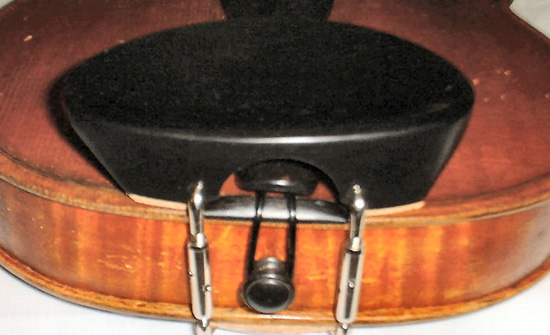
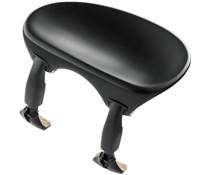
2. Get “Flesch” Chin rest or a “Wittner Chine rest, which are both centred over the tailpiece. This will make it easier for your fingers to reach the G string as your arm can be centred on the right side of the violin. Here is the “Flesch” Chin Rest below:

chinrest_flesch


Here is the “Wittner over the tailpiece” Chin rest:

Wittner Chin rest


3. Tilt the angle of your violin to give it more of a slope. I have noticed Itzhak Perlman has started to tilt his violin much more as he ages. It definitely makes it easier to reach the lower strings.

Itzhak Perlman tilting2

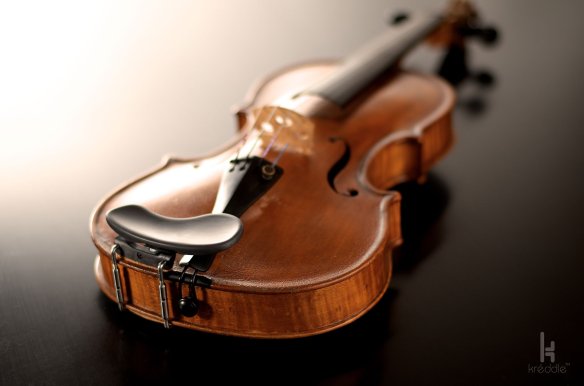
4. Use a Kreddle Chin rest which tilts side to side. If you tilt the violin like Itzhak Perlman does in the photo above, you will find that your chin does not fit securely on the normal chin rest. An adjustable chin rest such as the Kreddle, allow for your angle of the chin rest itself to be adjusted to give you the right fit for your chin so the violin won’t feel like it will slide out from under your chin. There are some difficulties, however, as the height is probably too high for some and the shape of the chin rest may be too flat for others.

Chin rest kreddle

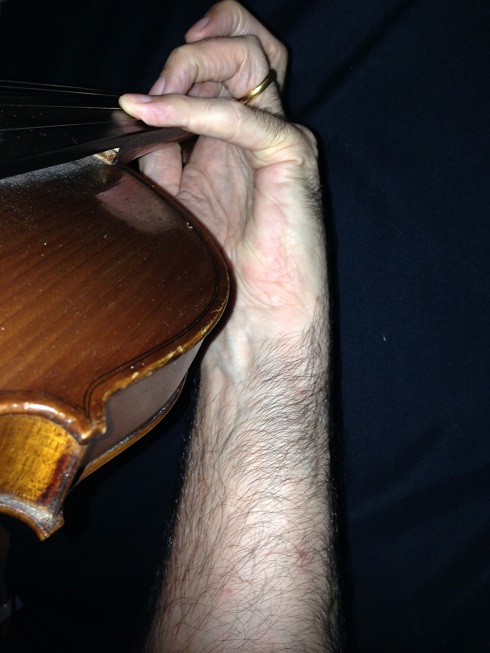
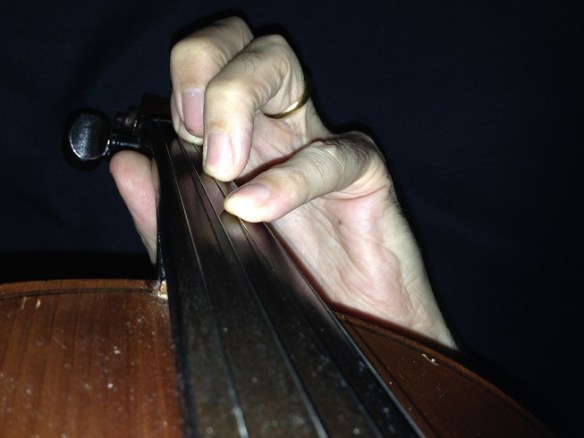
5. Have your knuckles parallel with the strings so that your 4th finger will have greater reach.

LH-straight knuckles

This will happen when your forearm has the elbow vertically under your hand.

LH-vertical arm


6. Have your wrist straight on the side of the 4th finger. This will enable your 4th finger to be above the string to extend its reach. See the photo above.

7. Have the left hand thumb placed opposite your 2nd finger rather than opposite your 1st finger. This is more natural for those with small fingers. However, you will need to reach back more with your 1st finger.

LH-Thumb opposite F2

8. Finally, you will need to make sure you have turned your arm/hand to have your fingers lined up near the same string. Many students have difficulty doing this because they have not allowed their THUMB TO TURN !!! Yes the thumb is part of the hand and it must turn as well so that the side of the thumb will be touching the neck. For a small hand, your thumb may even need to come under the neck so you can stretch your 4th finger.

LH-turned thumb & hand

9. One last finally! You must RELAX while you do your stretch which does sound like an oxymoron. Some parts of the hand need to remain flexible while other parts do the stretching work. Your thumb must be very relaxed. Other fingers which remain on the string need to be flexible enough to curve more to allow the 4th finger to stretch more. The wrist also needs to bend forward slightly as the 4th finger stretches.

All hands are unique! Some have short 4th fingers, so following the rules that work for most people will not always work for everyone. Be adventurous and take charge of your own playing to make it work for you – go ahead and break a rule or two. And try to enjoy your playing, this is the main thing 🙂

USEFUL WEB LINKS

USEFUL WEB LINKS:

Below are some very useful links that I use all the time or can recommend to save money. I will add to this list from time to time. Enjoy!

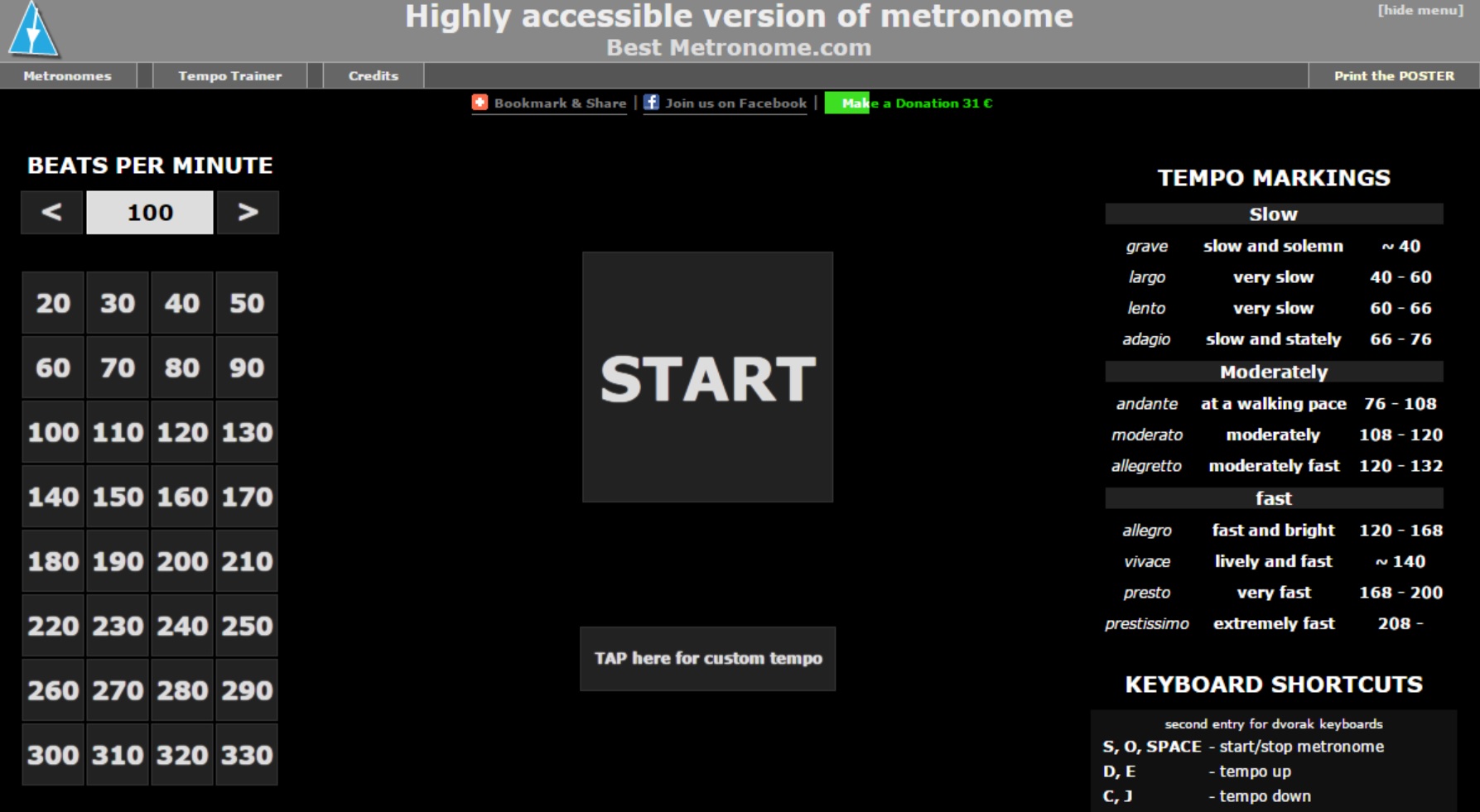
Metronome screen

1. copy the Youtube link of the Youtube video,

for e.g. http://www.youtube.com/watch?v=Ss1URTJYlfQ

2. paste your youtube link into the box underneath where it says: “Video URL to Download”

3. click the “Start” button then wait

4. click the “Download” button and a pop-up of your folders will appear

5. select the folder you want to save the file to and then press the “Save” button.

6. Now it is saved and you can click on the file to open it in any video playing program of your choice. I use VLC media play as it can slow down the recording.

  • SLOWING DOWN MUSIC: For slowing down MP4 or MP3 or any video or audio file: get VLC MEDIA PLAYER:

VLC

1. Go to a virus free download site at 1. http://download.cnet.com ;

2. select either Windows Mac iOS or Android;

3. in search at the top right type in VLC media player free download;

4. click on the VLC media player that is right for your computer whether it is 32 bit or 64 bit then save and open as you would any installed software.

Map of the Violin-Making Centres in Europe

Here it is: a map of the historic violin-making centres in Europe. For a long time I have wanted to have a map of all the famous places that violins were made. I could not find such a map anywhere on the internet, so I have made one myself and named the violin-making towns and cities in BLUE! Enjoy:
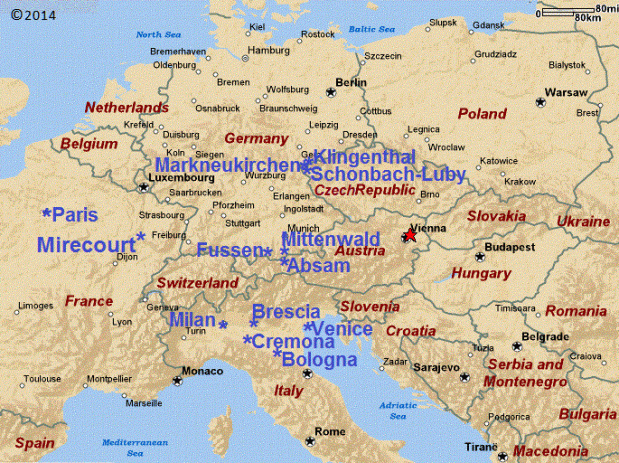
Europe Violin making-blue names

In future posts, I will add more information about the significance of these violin-making centres. Here is a summary organised by country and famous violinmakers who are also called luthiers: 1. Italy; 2. France; 3. Germany; 4. Bohemia-Czech Republic; 5. Tyrol-Austria.

1. FIRST OF ALL, in ITALY violin making began. It is also the country where many famous violin makers originated. Here is a list of some of the famous Italian violin makers: Gasparo Da Salo, Maggini, Amati, Stradivari, Guarneri, Bergonzi, Gagliano, Guadagnini,  Ruggeri, Testore, and numerous others.

Below is a map of the violin centres in Italy:
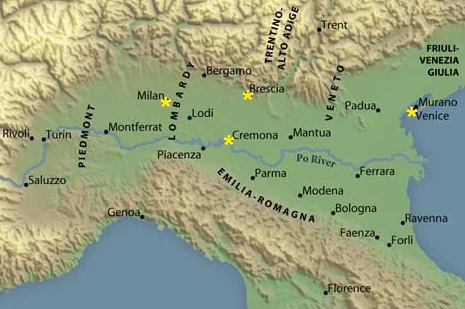
Venice and Northern Italy 1600–1800 smaller

The violin originated in Brescia where from 1530 onwards, the word violin appeared. Brescian master makers of string instruments dominated the violin market until the 1630’s, when a plague resulted in the death of Brescian masters. Cremonese makers gained influence after 1630. In BRESCIA, GASPARO DA SALO (1542-1609) was an important early luthier of the violin family. Da Salo apprenticed: his son Francesco, a helper named Battista, Alexander of Marsiglia, Giacomo Lafranchini and GIOVANNI PAOLO MAGGINI (1580-1630) who inherited da Salò’s business in Brescia. In 1620 Maggini moved to Florence.

In CREMONA, foremost is Andrea AMATI (1505-1577) in the mid 16th century. Some credit Amati with the violin’s “invention.” His legacy is the greatest due to the longevity of the influence of his descendants in Cremona till the 18th century: Andrea Amati: his son Antonio Amati (1540–1607), and his other son Girolamo Amati or Hieronymus (1561-1630). His grandson Nicolò Amati (1596–1684), apprenticed Antonio STRADIVARI (probably) (1644-1737), Andrea GUARNERI (1626–1698), Bartolomeo CRISTOFORI (1655–1731), Jacob RAILICH, Giovanni Battista ROGERI (1642–1710), Matthias Klotz and possibly Jacob Stainer. Carlo BERGONZI (1683-1747) was Stradivari’s greatest pupil and also worked for Amati and Guarneri. The Bergonzi family of luthiers continued till 1796. After the middle of the 18th century, only the Cerutis remained in Cremona.

In MILAN, in the mid 17th century was Giovanni GRANCINO (1637–1709), Carlo Giuseppe TESTORE (1665–1716), and his sons Carlo and Paolo. In Milan, in the early 18th century was Carlo Ferdinando LANDOLFI (1714–1787). Leandro BISIACH (1864-1945) in Milan, was as influential in the 1900’s as Vuillaume was in the 1800’s. The following instrument makers worked in Bisiach’s laboratory: Riccardo and Romeo ANTONIAZZI, Gaetano SGARABOTTO, Giuseppe ORNATI, Ferdinando GARIMBERTI, Igino SDERCI, Rocchi SESTO, Cipriano BRIANI, Camillo MANDELLI, Ferriccio VARAGNOLO, Camillo COLOMBO, Vincenzo CAVANI, Pietro PARAVICINI, Albert MOGLIE, Andrea BISIACH, Carlo BISIACH, Pietro BORGHI, Mirco TARASCONI, Leandro Jr. & Giacomo BISIACH, Iginio SIEGA and Carlo FERRARIO.

In VENICE in the mid 17th century were Matteo GOFFRILLER (1659–1742), Domenico MONTAGNANA (1686–1750), Sanctus SERAPHIN (1699–1776) and Carlo Annibale TONONI (1675–1730) who began in Bologna.

In ROME was David Tecchler (1666–1748) who was Austrian born.

In NAPLES, in the early 18th century, Alessandro GAGLIANO (1700-1735) worked in the shops of Amati and Stradivari. After returning to Naples from Cremona, he became the founder of the Neapolitan school which continued through his son Nicolo and then his grandson Ferdinando.

In the early 18th century was Giovanni Battista GUADAGNINI (1711–1786) who roamed throughout Italy during his lifetime.

2. SECONDLY FRANCE, in Paris and Mirecourt. In PARIS in 1815, Nicolas LUPOT  (1758–1824) was appointed violin maker to the king. Also in Paris was François CHANOT , who in 1818 employed Jean-Baptiste VUILLAUME (1798–1875). Vuillaume came to be widely regarded as the pre-eminent luthier of his day. Most 19th-century Parisian violin makers worked in his workshop, including Hippolyte Silvestre, Jean-Joseph Honoré Derazey, Charles Buthod, Charles-Adolphe Maucotel, Telesphore Barbe and Paul Bailly. MIRECOURT, is 100 miles from Paris and the centre of commercial violin manufacturing. Violin makers of Mirecourt in the early 19th century, were the famous Vuillaume family (Jean-Baptiste was born in Mirecourt and went to Paris at age 19). Also, in Mirecourt in the 19th Century were Charles Jean Baptiste Collin-Mezin, Charles Collin-Mezin Jr, and the Jérôme-Thibouville-Lamy (J.T.L) firm which moved to Mirecourt around 1760 and started making violins, guitars and mandolins.

3. THIRDLY GERMANY, in the area called “Vogtland,” which includes Bavaria, Saxony, Thuringia and into the Czech Republic in north-western Bohemia. The famous centres were Klingenthal and Markneukirchen in Saxony near the Czech border and Mittenwald in Bavaria near the Austrian border. In KLINGENTHAL in 1669, a Violin making guild was established with the Hopf family among others (Hobe was their family name). The Hopf family were religious exiles from Graslitz which was in Bohemia that is the Czech Republic. In Klingenthal, some famous makers were Dörffel, Glass, and Meisel. Around 1850 Klingenthal violin making suffered due to the American civil war, when North America stopped importing their violins. In the 1670’s, a Guild was established in MARKNEUKIRCHEN also. About seven million violin family instruments and basses, and far more bows, were shipped from Markneukirchen between 1880 and 1914.  Famous violin makers in Markneukirchen include Ernst Heinrich Roth, H. R. Pfretzschner, Albert Nürnberger-bowmaker, Heinrich Th. Heberlein Jr, the Knopf family, Arnold Voigt, and the Framus brand. MITTENWALD, near the Austrian border, was famous for violin making because of the Klotz family who have been making violins from the mid 1700’s till the present. Matthias KLOTZ (1653–1743) studied with Railich in Padua, Italy in the 1670’s and later with Stainer and Nicolo Amati.

4. FOURTHLY BOHEMIA, which is today called the CZECH Republic. Bohemia had famous centres called SCHONBACH (LUBY) which is 7 kilometres from the German town of Markneukirchen and GRASLITZ (KRASLICE) which is 5 km from the German town of Klingenthal. Please see the map below:
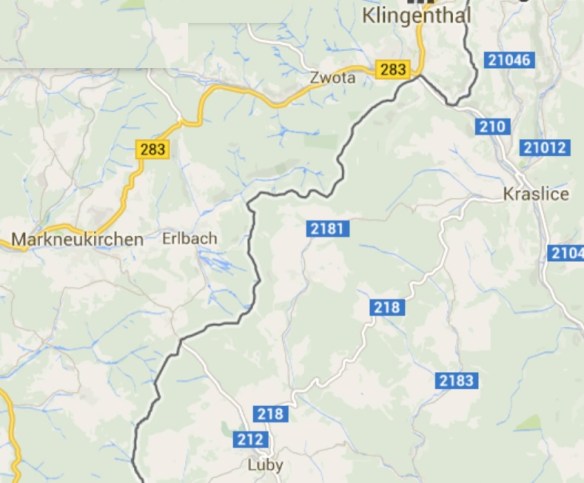
Markneukirchen-Luby

(From https://www.google.com.sg/maps/@50.3039251,12.3438899,11z)                               In the second half of the 1600’s Bohemian Protestant exiles moved to Klingenthal and Markneukirchen, Germany. In the 1700’s, there was much border crossing for the sale of Bohemian violins in southern Germany which was economically thriving. SCHONBACH (LUBY), Bohemia was one of the centres of the mass produced Bohemian/German violins of the late 1800’s which were exported all over the world. Many 19th and early 20th century instruments shipped from Saxony were in fact made in Bohemia, where the cost of living was less. Famous violin-makers in SCHONBACH (LUBY) were the PLACHTA family, SANDER, HOYER, and SCHUSTER families and John JUZEK.

Germany and Czech Republic (Bohemia) in the 19th and 20th centuries were responsible for numerous TRADE VIOLINS. They were called “Trade Violins” because they were made cheaply by semi-skilled workers, not by certified luthiers. In Germany and the Czech Republic these trade violins were made by farmers in their homes during winter when they had no other work. France was another country producing trade violins in Mirecourt where they used workers in assembly lines in violin factories such as those of J.T.L. The Tyrol which is now called Austria, also produced trade violins. Italy, however, never manufactured trade violins in factories as the Italians continued to have small workshops run by a master luthier and his apprentices.

5. FIFTHLY AUSTRIA, which was previously called TYROL, where Jacob STAINER (1617-1683) established his workshop in ABSAM/INNSBRUCK. His instruments were the most sought-after throughout Europe until the late 18th century, when orchestral music replaced chamber music as the dominant form. Stainer violins have a pronounced higher arching of the belly than the back; a broad lower back; some scrolls carved as heads of lions, angels, or women.

These are just some of the famous violin makers which I will no doubt add to in days to come.

References: http://en.wikipedia.org/wiki/Luthier; http://en.wikipedia.org/wiki/Jean-Baptiste_Vuillaume; http://en.wikipedia.org/wiki/Leandro_Bisiach; http://en.wikipedia.org/wiki/Jacobus_Stainer; http://en.wikipedia.org/wiki/History_of_the_violin

VIOLA DETAILED DESCRIPTIONS AND PHOTOS

1. VIOLA PRICING SUMMARY: 

The following Viola’s are available:

INTERMEDIATE 200 series 14 1/2″ VIOLA – costs $450 with an antique matt finish.

INTERMEDIATE 300 series: 15″ VIOLA – costs $590 with flamed maple back, sides and an attractive amber gloss varnish.

ADVANCED VIOLAS:

(SN:181 S$690) Advanced 15 ½” Viola-Stradivarius model – fully blocked and lined

SEMI-PROFESSIONAL VIOLAS:

(SN:176 S$1290) 15” Viola Copy of Guarnerius – Russian Spruce&Maple aged 16yrs

(SN:162 S$1290) 16 ½” Viola Copy of Stradivarius – Russian Spruce&Maple aged 16yrs

2. DETAILED DESCRIPTIONS AND PHOTOS: 

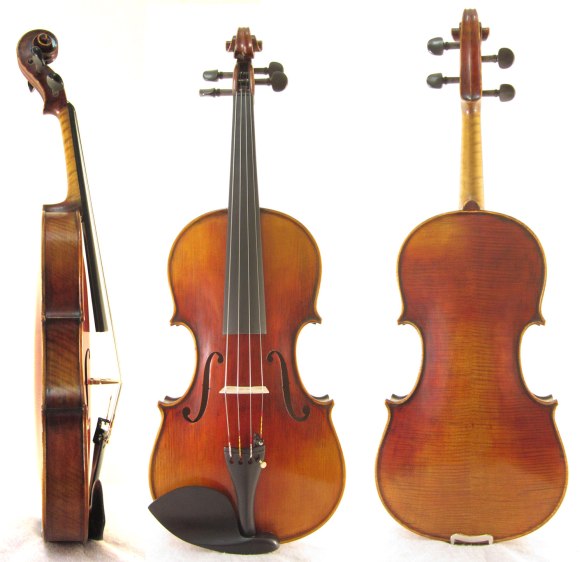
(SN:181 S$690) Advanced 15 ½” Viola-Stradivarius model – fully blocked and lined

181-Viola-15_5-Frontback


__________________________________________________________________________

(SN:176 – S$1290) Copy of a “Guarneri del Gesu” violin (15″) – discounted from S$1,690 due to varnish blemish under the tailpiece.

Made by a Russian violamaker in Beijing. (Russian Spruce and Maple) (highly recommended for tone, dynamics, expression and volume for soloists) 

Russian violamaking has a long history, earlier that even many European countries. Guarneri’s violins often have a darker, more robust, more sonorous tone than Stradivari’s. Russian spruce and maple have been used to achieve this. The tone on this violin is just exceptional, having a powerful, rich, clear tone. The craftmanship is excellent in every way.

Features:

  • 100% Handmade, 100% hand oil varnished
  • Selected Seasoned Russian Spruce Top, naturally air dried (over 16 years)
  • Selected Seasoned Russian Maple Back, Ribs & Scroll, naturally air dried (over 16 years)
  • Ebony Fingerboard
  • Hard-carved pegs, tailpiece and chinrest
  • Genuine Inlaid Purfling
  • One violin case and one Brazilwood Advanced standard bow

176-Viola15-Sidefrontback

________________________________________________________________________

(SN:162 – S$1290) Copy of a “Stradivarius” viola (16 1/2″) – discounted from S$1,690 due to varnish blemish under the tailpiece. 

Made by a Russian violamaker in Beijing. (Russian Spruce and Maple)

(highly recommended for tone, dynamics, expression and volume for soloists) 

Russian violamaking has a long history, earlier that even many European countries. This copy of a Stradivarius viola is 16.5″ full-sized and has incredible range in tone and dynamics responding well to the bow. The quality of the sound is evident in the first position and the higher registers where the same depth of tone is produced. Russian spruce and maple have been used to achieve this. The tone on this viola is just exceptional, having a powerful, rich, clear tone. The craftmanship is excellent in every way.

Features:

  • 100% Handmade, 100% hand oil varnished
  • Selected Seasoned Russian Spruce Top, naturally air dried (over 16 years)
  • Selected Seasoned Russian Maple Back, Ribs & Scroll, naturally air dried (over 16 years)
  • Ebony Fingerboard
  • Hard-carved pegs, tailpiece and chinrest
  • Genuine Inlaid Purfling
  • One viola case and one Brazilwood Advanced standard bow

____________________________________________________

SEMI-PROFESSIONAL VIOLINS detailed descriptions and photos

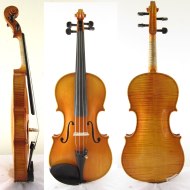
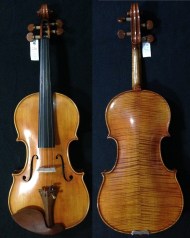
(SN:169 – S$1290) Copy of “J.B. Collin-Mezin” French Violin (4/4) – European Austrian Spruce –  Non-Antiqued Italian Oil Varnish Edition

___________________________________________________________

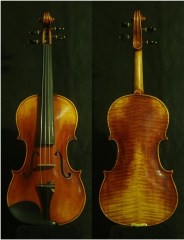
(SN:180 – S$1,150) Copy of Stradivarius – Russian Spruce

_______________________________________________________

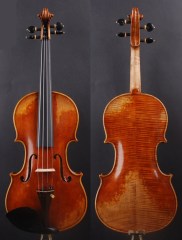
(SN:183 – S$1,150) Copy of Stradivarius “Jupiter”-1722 – antiqued Italian Varnish–Spruce aged 20 yrs

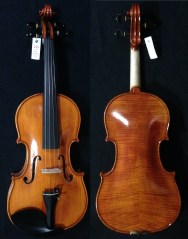
(SN:225 S$1490) Copy of Stradivarius Da Vinci of the year 1725-Spruce aged 15 yrs


(SN:228 S$1490)  Copy of Stradivarius Francesca 1694

(SN:229 S$1490)  Copy of Stradivarius Messiah 1716


(SN:169 – S$1290) Copy of “J.B. Collin-Mezin” French Violin (4/4) – European Austrian Spruce –  Non-Antiqued Italian Oil Varnish Edition

This copy of a J. B. Collin-Mezin French  violin, is a top level violin. Using the best materials of aged Austrian spruce and Italian made varnish, it is made with exquisite Chinese craftsmanship.

TONE: It achieves many highs in terms of tone, having a sophistication you would find in an old violin due to the high quality aged Austrian Spruce. It is balanced on all 4 strings, instantly responsive with good projection making this violin suitable for solo performances.

The market value for this violin easily exceeds S$2000.

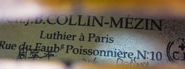
Copy of Original Collin-Mezin Label with Makers signature:

Features:

  • 100% Handmade, 100% hand oil varnished
  • Selected Seasoned European Austrian Spruce Top, naturally air dried(over 16 years)
  • Selected Seasoned One-piece Flamed Maple Back, Ribs & Scroll, naturally air dried (over 12 years)
  • Ebony Fingerboard
  • Hard-carved pegs, tailpiece and chinrest
  • Genuine Inlaid Purfling
  • One violin case and one Brazilwood Advanced standard bow

_______________________________________________________

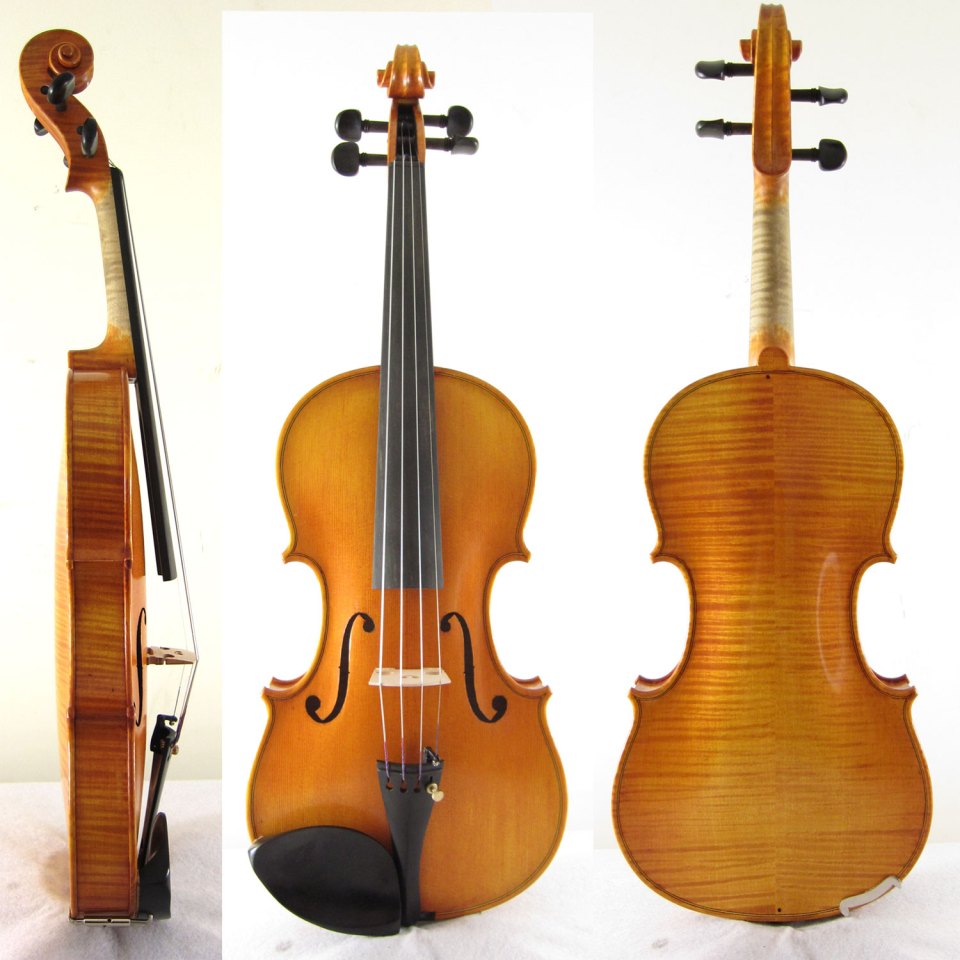
(SN:180 S$1,150) Copy of Stradivarius-Antique Varnish-Russian Spruce aged 15yrs

This is a copy of Stradivarius golden aged violin. I am very pleased with the clarity and power which the model possess. The sound is warm,sweet with a wide range of tone colors. It’s an excellent value for any concert level player who will benefit from great versatility and a broader tonal range.

The Construction and Materials of this Violin:

  • · Varnish:          Italian antique varnished
  • · Top:                Aged Russian spruce dried for 15 years
  • · Back:              Selected Seasoned Flamed Maple Back dried for 10 years
  • · Fitting:           Ebony fittings
  • · Fingerboard: Advanced Ebony
  • · Soundpost:    European spruce
  • · String:            Synthetic string
  • · Purfling:        Hand inlay

The Dimensions of the violin are:

– body length: 355mm; lower bout: 208mm; upper bout: 167mm; middle: 113mm.

(SN:180-S$1,150) Stradivarius -Russian Spruce

180-sides

_______________________________________________________

(SN:183 – S$1,150) Copy of Stradivarius “Jupiter”-1722 – antiqued Italian Varnish–Spruce aged 20 yrs

This is a copy of Stradivarius “Jupiter” golden aged violin. The tone has clarity and power and the sound is warm and sweet with a wide range of tone colors. It’s an excellent value for any concert level player who will benefit from great versatility and a broader tonal range.

The Construction and Materials of this Violin:

  • · Varnish:         Italian antique varnished
  • · Top:                Aged spruce dried for 20 years
  • · Back:              Selected Seasoned Flamed Maple Back dried for 20 years
  • · Fitting:           Ebony fittings
  • · Fingerboard: Ebony
  • · Soundpost:    European spruce
  • · String:            Synthetic string
  • · Purfling:        Hand inlay

The Dimensions of the violin are:

– body length: 357mm; lower bout: 206mm; upper bout: 164mm; middle: 106mm; Finger board Projection Height: 26.5mm.

183-Strad-Jupiter-frontback-medium 183-Strad-Jupiter-sides

_______________________________________________________

(SN:225 S$1490) Copy of Stradivarius Da Vinci of the year 1725-Spruce aged 15 yrs

This is a copy of Stradivarius Da Vinci is a golden aged violin. It is also known as the ex-Seidel Stradivarius named after a famous violinist Toscha Seidel who played it. 

The Construction and Materials of this Violin:

  • · Varnish:         Hand varnished
  • · Top:                Aged spruce dried for 15 years
  • · Back:              Selected Seasoned Flamed Maple Back dried for 15 years
  • · Fitting:           Ebony fittings
  • · Fingerboard: Ebony
  • · Soundpost:    European spruce
  • · String:            Synthetic string
  • · Purfling:        Hand inlay

The Dimensions of the violin are:

– body length: 355mm; lower bout: 208mm; upper bout: 167mm; middle: 113mm.

(SN:225-S$1490) Stradivarius-Da Vinci

(SN:225-S$1490) Stradivarius-Da Vinci

_______________________________________________________

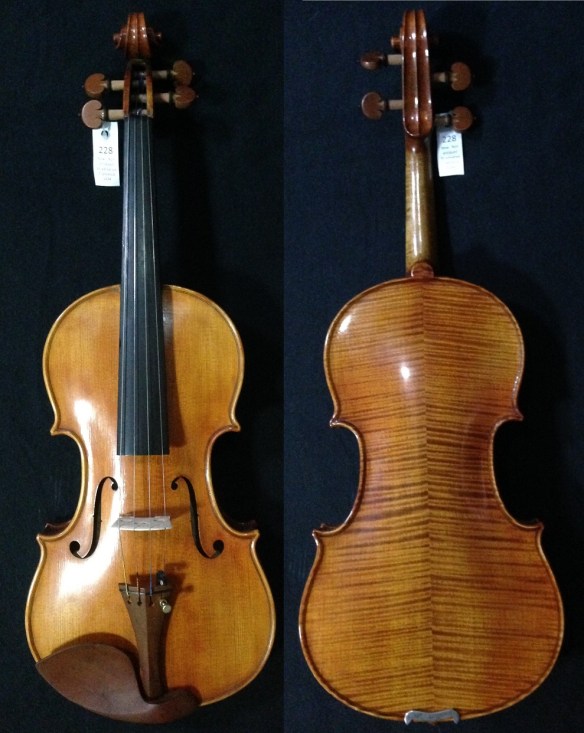
(SN:228 S$1490)  Copy of Stradivarius Francesca 1694

The Construction and Materials of this Violin:

  • · Varnish:         Hand varnished
  • · Top:                Aged spruce dried for 15 years
  • · Back:              Selected Seasoned Flamed Maple Back dried for 15 years
  • · Fitting:           Boxwood fittings
  • · Fingerboard: Ebony
  • · Soundpost:    European spruce
  • · String:            Synthetic string
  • · Purfling:        Hand inlay

The Dimensions of the violin are:

– body length: 355mm; lower bout: 206mm; upper bout: 166mm; middle: 110mm.

(SN:228-S$1490) Stradivarius Francesca

(SN:228-S$1490) Stradivarius Francesca

_______________________________________________________

(SN:229 S$1490)  Copy of Stradivarius Messiah 1716

The Messiah-Salabue Stradivarius of 1716 is considered to be the only Stradivarius in existence in as new state. The Messiah, sobriquet Le Messie, remained in the Stradivarius workshop until his death in 1737. In 1854, French luthier Vuillaume of Paris purchased The Messiah. “One day Tarisio was discoursing to Vuillaume on the merits of this unknown and marvelous instrument, when the violinist Jean-Delphin Alard exclaimed: ‘Then your violin is like the Messiah: one always expects him but he never appears’. Thus the violin was baptized with the name by which it is still known.”

The original Messiah violin is in like-new condition, as it was seldom played. However it was played by the famous violinist Joseph Joachim, who states he was struck by the combined sweetness and grandeur of the sound. It is one of the most valuable of all the Stradivari instruments.

The Construction and Materials of this Violin:

  • · Varnish:         Hand varnished
  • · Top:                Aged spruce dried for 15 years
  • · Back:              Selected Seasoned Flamed Maple Back dried for 15 years
  • · Fitting:           Boxwood fittings
  • · Fingerboard: Ebony
  • · Soundpost:    European spruce
  • · String:            Synthetic string
  • · Purfling:        Hand inlay

The Dimensions of the violin are:

– body length: 355mm; lower bout: 206mm; upper bout: 166mm; middle: 110mm.

(SN:229-S$1490) Stradivarius Messiah

(SN:229-S$1490) Stradivarius Messiah

_______________________________________________________

Violin Youtube Performance Videos

There is so much wonderful String music to be seen and heard on Youtube. Please come back to this post where I will embed some inspiring music from time to time.

Here is a marvelous Youtube video of a Sting Quartet called “Grupa MoCarta” performing Mozart’s “Eine Kleine Nachtmusik” in various musical styles, together with a singer Bobby McFerrin. Enjoy!


Here is one of my violin heroes Itzhak Perlman speaking about the bow grip:

And another video from Itzhak Perlman speaking about practice:


Music Reading and the Suzuki Method

Young children cannot read words on a page, however, they can talk very well.

They did not need to read words so that they could learn to speak.

Why should violinists need to read music before they can learn to play music!

Children learn speech by imitating and repeating their parents.

Let me summarize:

1. Children can speak before they can read words

Conclusion: CHILDREN CAN PLAY VIOLIN BEFORE THEY CAN READ MUSIC

2. Children learn to speak through imitation and repetition of sound

Conclusion: CHILDREN CAN LEARN TO PLAY THE VIOLIN THROUGH IMITATION AND REPETITION OF SOUND

This is the basis of the Suzuki “mother tongue method” of violin teaching.

WHEN DO CHILDREN LEARN TO READ MUSIC?

Most children can learn to read music as soon as they learn to read words. This is the way that I teach the Suzuki method and it seems that I am not alone in this. Please read:

“. . .. Suzuki continued the analogy of language/reading acquisition right through. He observed that children learned to speak first, years before they started to read or write Japanese characters. So he allowed these early starters to progress quite a long way on their instruments before he introduced music note reading. For a child starting at age 2½ or 3 years, they might even have reached book 4 before he introduced written notation. This was most appropriate for children starting so young. But, as soon as these children had grasped their Japanese characters and were starting to read fluently– that is they had developed an understanding of the connection between symbols on a page having another meaning, he would introduce music reading.”
(From an article called “To Read Or Not To Read” from “succeed with music”)